By Griffin Eckstein
One Saturday a month, DeKalb Avenue flies back in time to the late 19th century.
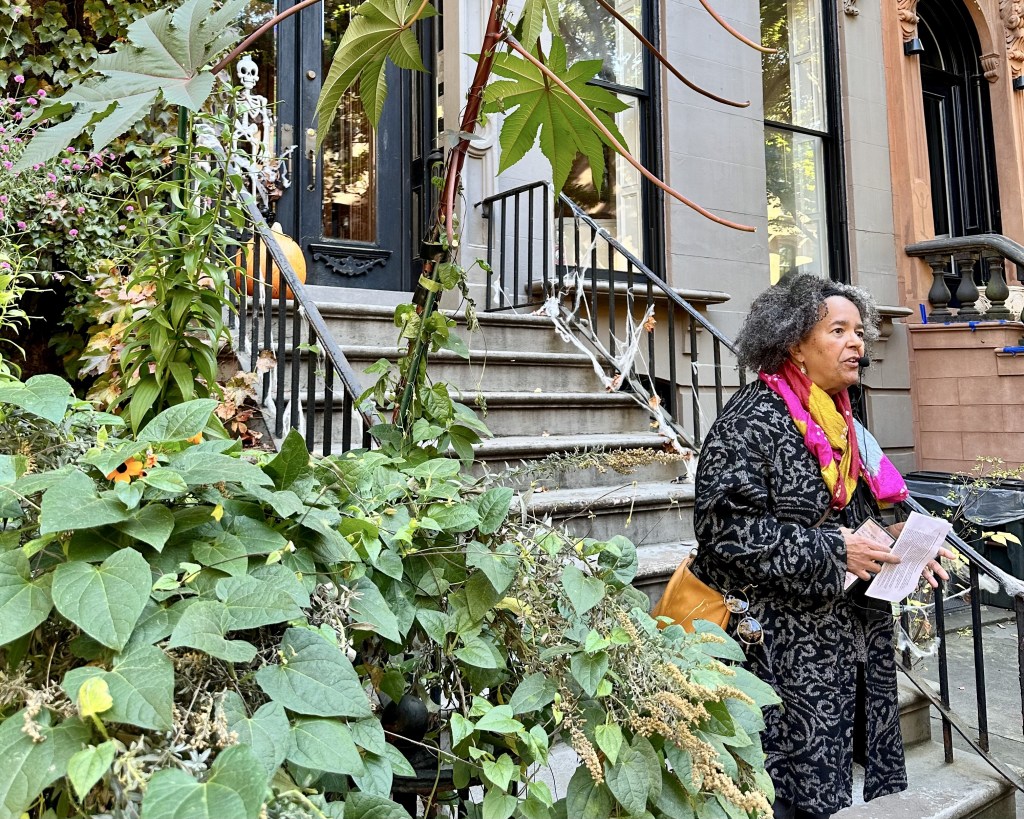
At least so it seemed to for the 30 or so guests on historian Suzanne Spellen’s Black history walking tour through Fort Greene in mid-October. Through her description, they got a glimpse inside the windows of Neo-Grec brownstones where middle-class Brooklynites made their homes.
Leaving from the corner of Fort Greene Park, Spellen walks visitors and residents alike through one of the most artistically important neighborhoods in New York City. Fort Greene is the birthplace of the Wu Tang Clan’s Ol’ Dirty Bastard and composer Bill Lee, Richard Wright and jazz great Slide Hampton made their masterpieces blocks from its park, and Spike Lee’s production company calls the neighborhood its home, Spellen tells the group.
Just a miniscule plaque marks 175 Carlton Avenue as the home of Wright as he wrote “Native Son,” which one Black participant said she’d walked by dozens of times without noticing before Spellen pointed it out.
“A lot of African Americans who’ve been on the tour who are in maybe [their] fifties, or older, they loved it because they didn’t know any of this stuff,” Spellen said.
Black Fort Greeners, who made up about a third of the tour group, said it was hard to learn about this history.
“I saw the tour last week and I had to join,” Andrea Fairweather Bailey said, a 55-year-old who calls Oxford St. home.
Fairweather Bailey visited Fort Greene regularly since the 80s, when her cousin lived a block from the park, moving in 24 years ago. She said that a wave of gentrification radically changed the neighborhood’s character and made the Black Brooklyn enclave less recognizable.
“We felt helpless,” Fairweather Bailey said of the period in the early 2000s since which the Black population fell in half. “We never knew about any decisions that were being made.”
When Black creatives turned Fort Greene’s reputation around in the 90s and 2000s, from a gang mecca to the “Buppie capital of Brooklyn” (a portmanteau of Black and Yuppie), they inadvertently priced themselves out, Spellen says.
Due to discriminatory redlining practices, Black Fort Greeners were almost never able to obtain a mortgage, and thus never own their homes. Instead, the vast majority were renters.
For Fairweather Bailey, this stop on tour reinforced her #1 rule of Black homeownership: never sell.
“I understand the power of ownership,” Fairweather Bailey said, adding that she wouldn’t be going the way of Laurence Fishburne, who as Spellen mentioned was forced out of the neighborhood by a rent increase.
For non-Black Fort Greeners, especially those who feel complicit in gentrification, Spellen’s tour helps them make sense of their place in the neighborhood’s history and work to keep it alive.
Rachel Freed, an Asian American who lived all around New York for 12 years before settling in Fort Greene, says she hopes to walk away with a more complete understanding of the neighborhood so she can share Black stories.
“I was telling people different facts I learned on the tour and then I thought I might have been messing up the facts. So, I wanted to do it again just so I could make sure I had everything accurate,” Freed said, explaining why she went for a second time on Spellen’s tour as the group approached the former FDNY Engine 256, once home to Spike Lee’s production company. “Everything just kind of speaks to me in this neighborhood.”
Spellen, who also does Black history tours in Crown Heights and Bed Stuy, said she was scouted by the Fort Greene Park Conservancy based on her passion for keeping the stories of Black Brooklyn alive.
“They found me… they wanted people to know Fort Greene more, come to the park more, and also, learn about African American history,” Spellen said, adding that she sees the tours as an opportunity to get people thinking about their neighborhoods’ under-told stories. “I think if there’s anything I want people to do after my tours, it’s to look around more.”

Leave a comment