By Griffin Eckstein
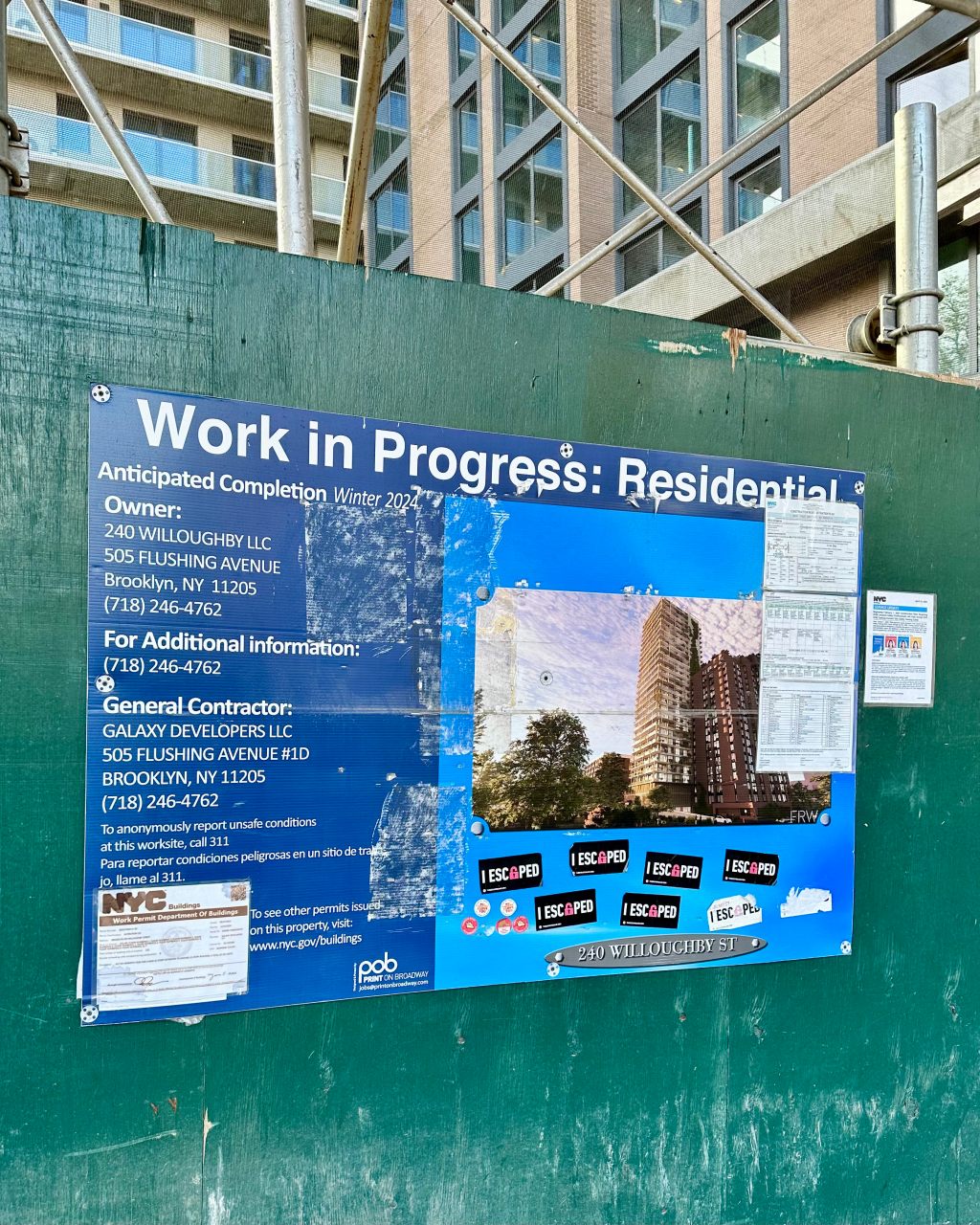
Along the western edge of Fort Greene Park early one Sunday afternoon, Joanna Steckman points to the roofline of the recently capped-off residential tower at 240 Willoughby Street, wondering why yet another tower sprung up without any community consultation. As finishing touches wrap up, Steckman bemoans the chaos of its truncated construction.
Steckman has lived blocks away from the site for nearly two decades in the University Towers co-op complex, built to bring housing to Fort Greene in the 1950s. But she says she’s being driven out of town by a construction boom.
“I get concerned about the safety, you know? They’ll throw these things up in six months, and then there’s ongoing issues,” Steckman said, noting that on this specific project, her neighbors faced issues with communication over sidewalk and traffic disruption and safety problems with flag workers.
The tower will house hundreds later this winter when it opens its doors. While Steckman and neighbors like her worry projects like it will rapidly alter their blocks, neighbors hope 240 Willoughby will provide much-needed relief amid a crisis-level housing shortage.
Blocks away, a crew fits the 27-story residential 19 Rockwell Place with window panes and finishing touches in anticipation of a mid-2025 opening. Together, the two towers will bring 472 new housing units to Fort Greene, at least 147 dedicated to affordable housing, their developers said.
Each sits on land not previously allocated for housing, the Rockwell project atop the site of a warehouse and the Willoughby tower on Brooklyn Hospital land.
In a borough in which over 44% of housing stock dates to 1939 or earlier, per a 2023 Census Bureau estimate, limited new supply sent Fort Greene rental and purchase demand soaring in recent decades.
Shortages have pushed renters like Luke Lavanway, a Fort Greene resident of four years, to get involved in city government. Lavanway testified at a planning commission hearing in July that the city was reaching a breaking point.
“I personally am shocked at what I have witnessed as a renter in recent years, including having to bid on rental leases, bidding wars to rent an apartment, and attending capped open houses with 40 or more people viewing a single unit at the same time,” Lavanway said in his testimony.
Real median rent – that is, accounting for inflation – climbed 108% in Fort Greene from 2006 to 2022, a span during which overall city rents by the same measure ticked up roughly 28%, according to the Furman Center.
“We got into the crisis because we didn’t build enough, and we didn’t build enough because some people were overly concerned with preventing their neighborhoods from changing,” Lavanway added. “To those who are trying to stop development, let me be clear. You are causing gentrification, displacement, and homelessness, and you are doing grave damage to the future of New York City, whether you own property or not.”
Lavanway’s assessment matches that of many, including the City Councilwoman representing his home.
Councilwoman Crystal Hudson, who represents Fort Greene and neighboring Prospect Heights, Clinton Hill, Crown Heights, and Bed-Stuy, championed a bill at City Hall to make housing construction easier.
While Fort Greene added just three net new units of housing in 2023, nearby Bed-Stuy added 554, and Prospect Heights tossed up 810 new units.
“My district is 8th out of 51 for producing the most affordable housing units across the past decade, and that’s a record I’m proud of,” Hudson testified at a Nov. 21 land use committee meeting. “Yet some parts of our city haven’t produced anywhere near this amount of housing. There are some neighborhoods that have barely seen one new building go up in recent years.”
Not all Fort Greeners are afraid of new housing. Some, like Washington Ave. resident Luke Tedaldi, celebrated new developments.
“I’m just happy for new housing to be built. I think, like, that’s the struggle right now, living in New York,” he said, standing a few dozen yards from the scaffolding at 240 Willoughby. “I’m all for more affordable housing as well. I think that New York has its limitations in terms of how it does that, because it’s–whether or not it has tried to–over the last decade, it’s really become a place for the upper class.”
Tedaldi, who along with his wife and child have been in Fort Greene since 2021, are looking for a bigger place, but feel burdened by cost.
Tedaldi also slammed neighbors critical of new affordable developments, questioning their instincts to pull the ladder up behind themselves.
“They moved here when it was reasonably affordable. It’s now very expensive. And so I imagine that they’re probably less than happy to see affordable housing go up,” he said. Tedaldi said, if anything, he hoped to see more construction on the Clinton Hill side of the neighborhood going forward.
While the western reaches of Fort Greene have seen some spill-over from a building boom in Downtown Brooklyn, points east of the park have seen virtually no construction. City of Yes, Mayor Eric Adams’ plan to ease housing shortages in the city, would change that.
The proposal updates zoning rules and removes bureaucratic obstacles to construction, cutting parking minimums and upzoning low-density residential areas to allow taller, mixed-use projects.
The plan specifically loosens building regulations several blocks east of Fort Greene Park currently zoned as low-density, increasing housing capacity by potentially hundreds of units.
In Fort Greene, low vacancy and even lower construction proved the perfect recipe for a form of gentrification that pushed homeowners and tenants of color out of the neighborhood at rates higher than surrounding areas.
As rent prices soared between 2006 to 2022, the percentage of Black and Hispanic residents fell by 44% in the neighborhood.
“If we don’t maximize our opportunities to build, rents will only continue to rise and push out longtime community residents, especially older black and brown New Yorkers who live on fixed incomes,” Hudson warned.
The plan eked through the City Council in early December with some tweaks, still projected to deliver 80,000 new housing units by 2040.
Steckman expressed skepticism with the City of Yes and the idea that larger housing developments were more than a band-aid over a deeper housing issue.
“I get concerned with the speed in which these properties are going up, and unfortunately, I don’t think Eric Adams is in a position, you know, [to solve the crisis,]” Steckman said. “The fact that anything that he has put together in terms of plans– I would question given his own issues right now and potential indictments with having taken a lot of money.”
She agrees that prioritizing housing solutions that keep Fort Greene affordable to residents of color are essential, but said the neighborhood never needed the type of construction it’s experiencing now before.
“What I always appreciated about Fort Greene, Clinton Hill was there was a real sense that, instead of just a gentrification and pushing other people out, you had people that were um native to this community that were coming back and rebuilding,” she added.
“The Spike Lees, the businesses along Myrtle, I felt was a community for the community… the developers have seen a massive opportunity to make a serious amount of money. But at, you know, the disservice to those of us in the community.”

Leave a Reply